|
| Lovely rustic yurt courtesy of the Oregon Parks and Recreation Department, Harris Beach State Park, near Brookings, Oregon. (These begin at $39 per night.) |


Waking up in my yurt to the sound of the rain tap tap tapping was not an ideal way to spend my spring break, but I am an Oregonian so I was more than prepared to deal with it. With my old sleeping bag from back when I used to backpack up mountainsides, and a Pendleton blanket with a big salmon on it that my dad had given me, I had slept very well the night before and I was ready to head out for an expedition of my own. My plan was to drive at whatever pace I felt like to my next destination, and to have fun and to relax while doing so. I had no idea which native plants I would see because I'd promised myself not to plan this all out in advance. I was just going to look at whatever I could find and make note of it. I also took along not only my handy digital camera, but a Holga and a funky Japanese camera too. With some special film inside, those other cameras should turn out some great images, but of course, I have to wait for those to be developed. I can wait.
 |
| Our large trees can become very dangerous during the winter months especially when the waves are unpredictable. |
The last time I drove through Brookings it was Thanksgiving 2009 and my husband and I were driving to Gold Beach for the night. As we flew into town I saw a sign for an Azalea Park and that was news to me! I thought I knew about all of the plant parks so I vowed to return. Over a year later, there I was last week, after having visited the harbor for some coffee for the road.
The ancient native azaleas in this thirty-three acre park have been here since Lewis and Clark visited—what was to later become the state of Oregon—back during the winter of 1805-1806. (Sure the Lewis and Clark Expedition was nowhere near these shrubs, but that's a long time for a shrub to live so it should be noted I guess.)
No one really noticed or cared much for this stand of plants until 1937 when inspired folks cleared the old pastures, removing the overgrown vines, and later petitioned to have the native shrubs designated as a State Park. From 1939-1993 their wish was granted, but then in 1993, ownership and maintenance of the park reverted to the City of Brookings. Since then, it has been revitalized, with many new additions, and it is currently looking absolutely wonderful.

The group of volunteers that has stepped in to care for the park has done so because there are five varieties of endangered native Azaleas here. They knew what a treasure this is, and thanks to them, we still have these plants to enjoy.
I was only a bit sad that the plants are not labeled at all, but it may be done in an effort to keep people like me from snipping at them. I am unable to find information about the actual plants online, and I would love to know more about all of them, and genetically what makes them special, but as for as I can tell, the only native azalea is the
Western Azalea (
Rhododendron occidentale) so these must all be different natural varieties of the same plant. Curiouser and curiouser... Yes, now I see it all clearly. The link really helped.
The next stop was the Pistol River and its wayside. I had to stop there because it had been the name of my yurt the night before. Not only did I have the whole vista to myself that morning but, lucky me, I found some random plants sitting here and there not far from the car. I also found a bit of history.
When I read this Oregon History sign I thought again of genealogical history but this time it was my husband's and not mine. At the time this skirmish occurred, during March of 1856, my husband's French Canadian ancestors had already been busy in the West for quite some time and had already made history themselves. Ten years beforehand, a relative of my husband's was also attacked and killed in Southern Oregon, but it was while he was camped on Klamath Lake in the interior with an expedition party. One month later that same group was back in California taking part in the Bear Flag Revolt in a very strange moment in the history of California.
Basil LaJeunesse was killed while the group slept beside the lake one night. It was an Indian attack and he received a hatchet to the head on May 9th, of 1846. Asleep beside him was his dear friend and expedition companion, Kit Carson. Yes, it was that Kit Carson.
Working with John Frémont, the American military officer and explorer, they'd both been hired to travel to California along with a group of fifty-three other men by the President of the US. It was officially an exploration party, but in reality, they were being hired to spy on the Mexican government in California. The Mexican officials figured it out and they were asked to leave. That's how they ended up just over the border in Oregon Territory. That night Frémont had forgotten to post a guard because he was waiting to receive word from the President as to how to proceed with California since at that time, they'd expected a fight with Mexico. The fight never occurred.
Back home in Wyoming, Basil's older brother married a Shoshone woman from Southern Oregon and he opened up a trading post named in his brother's memory. Fort Seminoe (after his brother's Catholic baptismal name) operated from 1852-1855. The Oregon Trail went right past their front door as did the Mormon and California Trails. (Four of my great-great-great grandparents walked right past Charles and his wife on their way from Kentucky to Oregon and if they'd only known someday I would marry one of their descendants I cannot imagine what they would have thought.) Eventually, as tensions with the Natives Americans grew, Charles was forced to hand the fort to the Sioux in 1855 and during the same Indian War era, he left to work as a tracker, and was killed somewhere on the Yellowstone River. His body was never found but each year tourists and fly fishermen flock there like geese. It is still hard for me to blend these two different histories of a place together since they honestly slammed together rather quickly during the last few generations but I am working on it. The fact that my father has made a life for himself as a well-known fly fisherman has only served to convolute this whole funny reality even more.
I own a copy of the journal Frémont wrote during that fateful expedition and it has great plant descriptions throughout. It is kind of a nice read to be honest, but it is still shocking to have learned all of this about my husband's past and to tie him to historic characters mentioned in books is still strange.
Due to adoption, none of this information was known until recently. All I can say is that it is hard to change how you see your place in the world when you are in your 30s. One day you know your story, then the next, well, you're simply forced into becoming a different person. Going through this experience with him has been fascinating but it is slow going.
I return to plants again, and though the tangent may seem a bit off, I hope you enjoyed it. More bits and pieces will appear from time to time.
 |
| Coastal Strawberry (Fragaria chiloensis). |
 |
| I don't know what this is either but it was hanging in up high above the ocean so I figured I should include it too. |
 |
| This must be some kind of Manzanita. |
 |
| I have no idea what this is, but I am sure that one of my friends will let me know. |
I'm not sure how long it was before I stopped again, but I did not too far down the road. The ocean was amazing that day and I was beginning to get more and more excited about all of the plantlife I was finding all over the place. In so many ways, I was really happy that day. After a long winter, and a lot of medical issues, that day was just the right thing.
 |
| I have no idea what this was, or if it was even native, but it was there. |

 |
| This is some kind of Lupine with a grass. |
 |
| Sea Pink (Armeria maritima). |
 |
| Just off the highway and all to myself. |
When I landed in Gold Beach, I pulled over to take these pictures for those of you who have not yet seen what we have here in Oregon for our tsunami public education signage. I like the signs a lot and am happy that public safety efforts have started in our state, but we are far from ready. When the earthquake hit Japan just a few weeks ago many of us already understood that meant to take cover and to use caution but we were certainly not ready for anything.

Luckily we were not wiped out, but we will eventually begin finding the debris from Japan on our coastline. It is expected to arrive in
3 years but it may only take 1 year.
I am fairly confident that the mess will arrive here just as the many fishing floats have for years and years. Beachcombers have always cherished the blown glass objets d'art but something really different is heading our way now.
Just down the road at the beach I discovered this nice little piece of ingenuity. When I was a girl, I used to make shelters like this with my friends and their families. At camp, we also learned how to make ones with tree boughs for a roof. Transported to any garden setting, this would be really wonderful, especially in a
stumpery.
 |
| A wind shelter, Gold Beach, Oregon. |
This is why I was really there though. Like many others, I drive to this part of our coast for the rocks—the beautiful rocks that I handpick for my garden.
 |
| Agate hunting, Gold Beach, Oregon. |
After loading up the reuseable grocery bags I jumped back into the car and headed north. Again, I randomly selected several waysides and parks and was delighted by all of the additional plants I was able to spot that day.
 |
| Oregon Myrtle or California Bay (Umbellularia californica). |
 |
| I am not completely sure of the mix here, but there are at least three native plants I can spot I just cannot recall all of their names right now. |
 |
| Ok. It was a grave wayside. Again, the Native Americans are blamed as having massacred but I have such a hard time with that since we were taking all of their land and resources away from them. Still a very touchy subject for many Americans and when you see things like this you really have to stop and wonder. I am sorry they lost their lives, but I am glad that this park was set aside for us to sit and think about this dark part of our history. |
 |
| Not sure of ID, but it is really pretty. |
 |
| Yellow Prairie Violet (Viola praemorsa). |
 |
| Rattlesnake Plantain or Rattlesnake Orchid (Goodyera oblongifolia). |
 |
| Red Flowering Currant (Ribes sanguineum). |
 |
| Stuff that looks like Kraft Macaroni and Cheese but it is actually something slimy growing on the tree. |
 |
| Skunk Cabbage (Lysichiton americanus). |
 |
| Sweet Coltsfoot (Petasites frigidus). |
 |
| Non-native Teasel (Dipsacus fullonum). |
 |
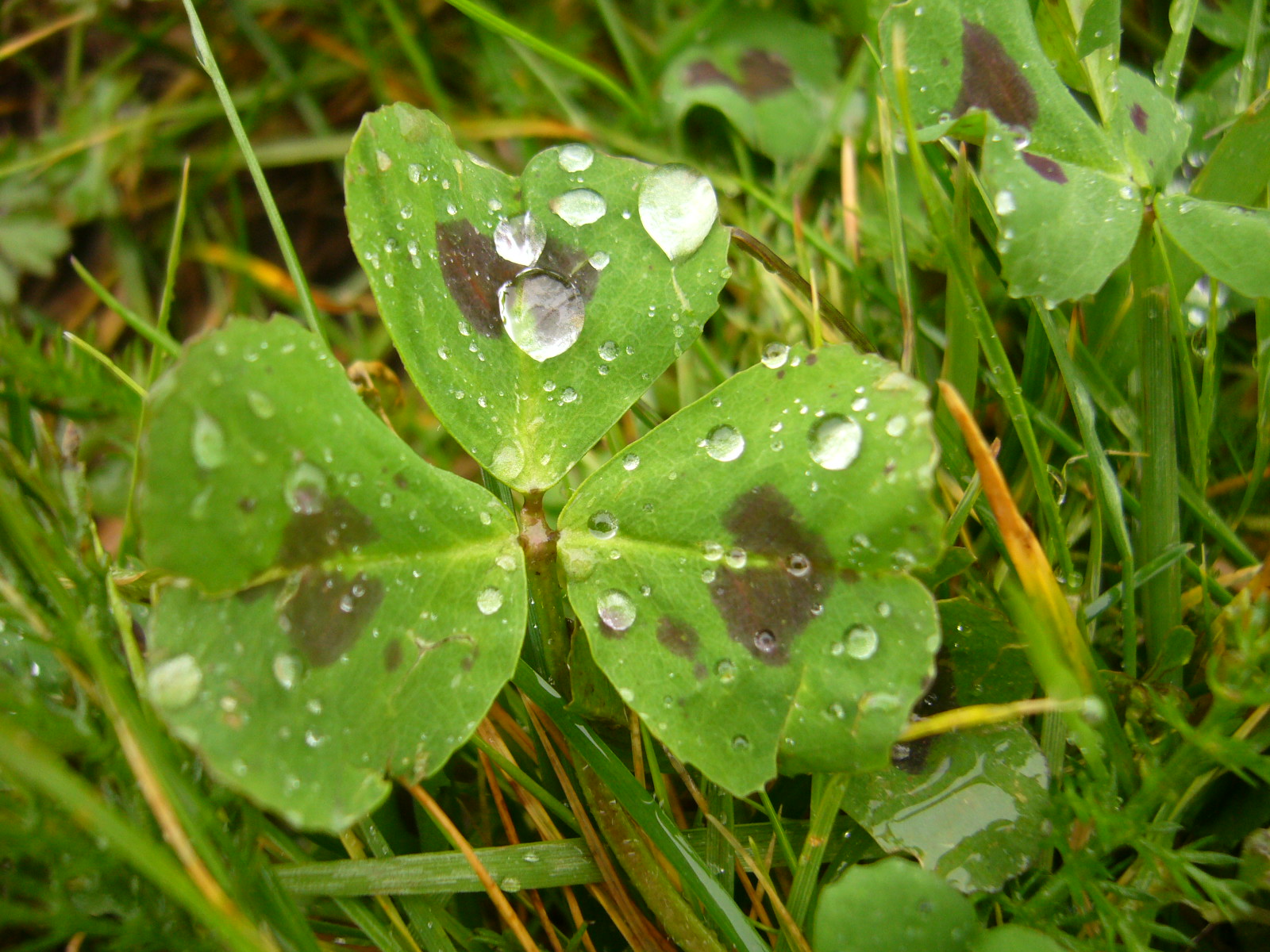
| Unknown Oxalis. |
 |
| Rock collecting opportunities. |
 |
| This is the only native Sedum spathulifolium 'Cape Blanco' that I ran across and it was on a suicide mission in the sand so I liberated it to higher ground. This is a really slow-growing sedum at my house for some reason but I have no idea how one kind can grow so quickly and another slowly. |
 |
| Unknown coastal pine. |
 |
| Evergreen Huckleberry. I HIGHLY recommend these bushes for their berries. (Vaccinium ovatum). |
 |
| Not sure if this is Usnea lichen but it looks like it. This is not moss. If we have 20 words for rain in the NW, we have at least 200 names for different kinds of creepy things that grow on trees. |
 |
| It's another Oregon Myrtle though I prefer Headache Tree because it is so strongly scented. (Umbellularia californica). |
 |
| Salal (Gaultheria shallon). |
 |
| Red Flowering Currant (Ribes sanguineum). |
 |
| Ocean of non-native Gorse (Ulex europaeus). |
 |
| Stand of native Pacific Coast Iris on a hill facing the Pacific Ocean (Iris douglasiana). |
 |
| Not sure exactly exactly what this is. |
 |
| Cannot remember the name but this one is familiar. |
 |
| Female Coast Silk Tassel shrub (Garrya elliptica). The male catkins are much showier and longer and often show up in photos. I tried to find some, but all that was available were the female catkins which were still clinging to ripe seeds from last year. Impressive and fruitful. |
 |
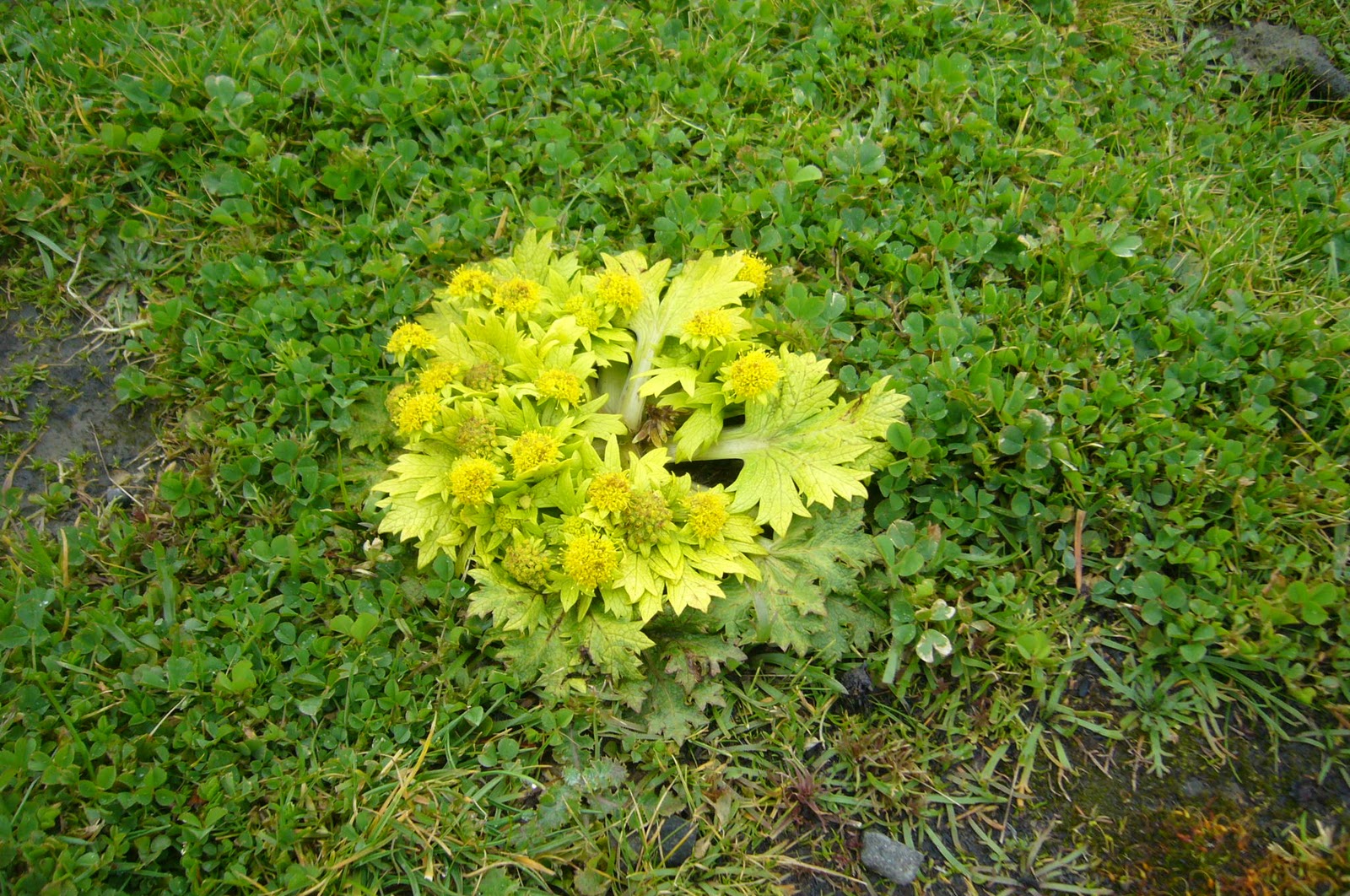
| I have no idea what this fern-like thing was that I found growing in a flooded meadow. Any hints botanical buddies?? |

Bearberry of Twinberry Honeysuckle (
Lonicera involucrata var.
ledebourii). These are pretty plentiful all along the way but nevertheless I kept finding myself wanting to take picture after picture of their little blooms.
Some of the last flower pictures I snapped were of these two lovelies. I am pretty sure the are
Clarkia, but I really cannot figure out which one they are. Maybe someone just tossed seeds out the window to see if they would grow down at the coast in a pretty harsh environment where a river meets the ocean. They looked native to me though.
As I rolled into Coos Bay I was greeted by the sight below. Part of me could not help but think of the movie
The Goonies and my thoughts went up Highway 101 to Astoria. What a great day I had and right now I really wish I was back on the road.


 Waking up in my yurt to the sound of the rain tap tap tapping was not an ideal way to spend my spring break, but I am an Oregonian so I was more than prepared to deal with it. With my old sleeping bag from back when I used to backpack up mountainsides, and a Pendleton blanket with a big salmon on it that my dad had given me, I had slept very well the night before and I was ready to head out for an expedition of my own. My plan was to drive at whatever pace I felt like to my next destination, and to have fun and to relax while doing so. I had no idea which native plants I would see because I'd promised myself not to plan this all out in advance. I was just going to look at whatever I could find and make note of it. I also took along not only my handy digital camera, but a Holga and a funky Japanese camera too. With some special film inside, those other cameras should turn out some great images, but of course, I have to wait for those to be developed. I can wait.