Showing posts with label Opuntia. Show all posts

Saturday, May 3, 2014

Sicily: Part Two (Palermo and some of Ancient Sicily)

The chronology of our Sicily trip is a bit out of order in these two posts but I'm trying to remain focused on a few themes related to gardening and the green spirit. "Buon divertimento!"
Cucuzza squash in the Mercato di Capo in Palermo. 
We'd planned to drive into Palermo twice during our time in Sicily but a food poisoning incident put an end to that plan two days before we were scheduled to fly to Rome. What's worse is that I'd intended to spend that last day at the botanical garden but all I could do was vow to return. What's a girl to do? Seriously.

This meant that we had to leave the island with only a few memories of the chaotic città di Palermo, but at least we saw the catacombs and il Mercato di Capo. My other hope all along had been to visit a market in Palermo and somehow we landed at one of the largest quite by accident.

Ok, maybe it was fate after all, a big hug from my Sicilian family from beyond the grave...
My great-grandpa Frank Amato with a cucuzza he grew in his garden in SE Portland. Since it's much colder here in Oregon than in Sicily I know this was a triumph for him. I'm sure this photo was taken to always remember this accomplishment. 
All I could think about that day in Palermo was my family. Everything I saw as I looked around brought color and life back into the black & white photos I'd grown up seeing. This awakening of snapshots invigorated me and although I walked beside my husband, I knew then as I know now that this experience was my own and I embraced every awkward moment of it. (Honestly, he'd bought a platter of pastries and was reliving his own Italian childhood as we walked through the market that day.) There we were walking together reliving our own memories yet his were real and mine were only the half-imagined stuff of stories, old photos, and dreams mixed with raw emotions. I wanted so badly to be a little girl walking beside my great-uncle Charlie (holding his hand), or to be with his best-friend, cousin Joe.

It felt strange to be in Sicily alone.
Il Mercato di Capo.
Yet, that was the beginning of an ongoing chain of epiphanies for me as I walked through the market.

Any American with a strong tie to another culture can make choices—either cut their ties and let the past remain the past or inject new life into it. I've always straddled my Italian-American identity and dealing with being bi-cultural in Oregon in the 1980s was not easy. Countless times Americans have told me I wasn't Italian enough to be Italian and they were wrong. Children should never have to grow up defending their identity. They have no idea how painful and damaging those words were to me.

Besides, Italians don't quantify their identity, they qualify it. That's why I have a blood right (jus sanguinis) entitling me to Italian citizenship. I've been given that choice by my bloodline. In Italy it doesn't matter how much Italian blood you possess, what matters is what you do with the heritage that's been passed on to you through birth.
As a girl I'd looked at photos with family members and I'd been told that these were a part of who I was and of my identity but I know now the damage that can do over time. I was always confused because those photos weren't of my life in the 1980s with a mother who wasn't in the least bit Sicilian and with two brothers who in no way cared about any of this.

We're the American generation that really is able to choose to be called American but I'm the only one of my siblings who's chosen to remain hyphenated. This is what happens in bi-cultural and bi-racial families. Individuals must be allowed to decide who and what they're going to be and the family fabric will change.

I wish I had siblings like me, but I don't, and honestly, we're not that close. For me it's always felt like a cultural rift or divide but it's difficult to say.

Instead of dwelling, I've lived my own independent life and have chosen to remain Italian through my marriages and I'm pleased now to have an Italian mother-in-law. It's the way my life is, has been, and will be. I'm happier now than I've ever been. I love to cook and garden. I have an undying love for produce and fresh food. And when I wake up I drink my coffee and spend a lot of time everyday thinking of making new dishes for the many friends I invite to eat at my table.

Seeing a market in Sicily one day can make all of this happen if you're the right kind of person in need of that kind of emotional catharsis. I've been crying out for that experience for so long and it's sad I had to wait for so long and travel so far but I'm a better person now.

Ok, now back to our regularly scheduled programming…
This mosaic floor depicts the bountiful harvests available on the island during the era of the Roman Empire.  Many of the orchards had been planted by the Greeks centuries before so there was already an agricultural system in place. 
Leading up to that epiphany in the market we'd spent the day before driving from Termini to the Villa Romana del Casale in the interior of the island. The villa contains the largest collection of Roman mosaics in the world and is an UNESCO World Heritage Site.
The "bikini girls" is by far the most famous mosaic work in the complex. Seeing it in person was a highlight of the trip for me. It was absolutely nothing like I had imagined. The figures are quite large and they're more real when seeing them in person. The shading on the leg muscles was much better than I'd remembered seeing in books.

I also noticed all of the botanical bits and pieces as we walked through the entire complex. Recounting what I knew about the meaning of each plant as we looked at the mosaics was interesting to John. Although he has a Master's degree in history, with an empasis on the Italian Renaissance, he'd never read much about ancient Rome and Italy. It was fun sharing with him.

Nowhere in Rome will you see anything quite like the Villa Romana del Casele. It's huge and very well preserved. Walking on walkways overlooking all of the rooms and floors was a brilliant design plan too. You see so much!

It really made me long to return to my days as a student of art and landscape history. I'd once worked hard to specialize in ancient art, philosophy, and history. Using my knowledge while there though really enriched the experience for me. John left knowing a lot more about Italy's flora and the history of it too although we both still have so much more we want to learn.

Driving several hours though the countryside, stopping in the road for a shepherd and his flock of sheep, and chatting all day with John about his impressions of the place made for a dream-like day. We still had one more stop though.
We drove for a few more hours to Agrigento, on the southern coast of Sicily. This is where you'll find the Valle dei Templi. In addition to being a national monument in Italy, it's also one of the best places in the world for Ancient Greek architecture. 

The temples are above the valley, along a ridge. As we drove into town they were difficult to miss. The view from the road below was truly breathtaking and I was left speechless. I've had few spiritual moments in my life, but that afternoon was truly a spiritual pilgrimage for me. 
Yes, there was an attached garden too but its gate was closed. 
And it was so lovely that in the middle of the ancient Greek temples, catacombs, and necropolis you'll find this humble home built by an Englishman by the name of Hardcastle who came to "save" the temples. I will not get onto the topic of what other Europeans have done in Italy in regards to preserving the history of the ancient and artistic heritage we all seemingly share, but I'm certainly of the opinion that this lovely eyesore should have been built somewhere else—oh, and that England should hand back the Elgin Marbles to Athens. 

(I also highly recommend the novel Nike: A Romance by Nicholas Flokos. It's a love story like no other concerning the repatriation of the Winged Victory statue in the Louvre.)

This should probably make my sentiments and opinion quite clear. 
Here I am standing in front of the Temple of Concordia.
It is sad to me that John does not share my interest in the ancient world, but he has other things to buoy his interest up north and happily we ended up learning a lot from one another. 

Life is a funny thing and we all need our own raison d'être as the French like to say. I think it's important that we each find our own and respect others'.  There truly are so many options out there that make life truly worth living. 
As we walked back to the car, I spotted this sign and glimpsed over to the area it was describing.

Only exhaustion at this point kept me away.

I wanted the signs to tell me more—so much more.
But my body was in no mood to make the descent.

I definitely need to study more and return refreshed and prepared to Sicily.
We drifted from that ancient universe to Palermo and then to Cefelù after several trips into Termini. The days truly all blend together now. 

That evening in Cefalù I purchased seeds at this shop for my mother-in-law and myself and it was a bit like a candy store for me. All the necessary new Italian vocabulary I needed to communicate with other gardeners was there on the shelves. 

(This is not vocabulary you learn in your regular Italian language course.) 

Then I ate something that gave me food poisoning and the trip took a turn. 
John and I after a day of bed rest due to food poisoning. Our nausea made walking difficult but we made it down to the common area at least. 
Our last full day in Sicily was spent recovering from the food poisoning. John only had three bites of the aranchi rice ball that made me so sick so at least he empathized. We were both unable to move much that day so we just processed what we'd seen so far and John and I talked about what was yet to come.
Wild native Gladiolus italicus growing in the olive orchard. 
I wandered around where we'd been staying to take more plant pics and after John returned to our room, I sat with the Sicilian tourists at the restaurant below our lodgings and soaked up their noise as I wrote to friends back home using the Wifi connection.

The day-trip tourists ate daily at the restaurant and then danced to loud music and talked to one another. (Yes, Sicilians love agroturismo too and they'd all paid to take a bus to artichoke country to spend time basking in the harvest.) We were largely ignored as outsiders, but that last day it changed for me.

The day before I'd heard an old man on the patio playing traditional Sicilian music with his mandolin. My heart had seriously skipped a beat. That day he was back. The tourists piled onto the buses and only he and I were on the patio. He hobbled over to me and sat down speaking Sicilian dialect as he slowly crossed the distance. Looking right into his eyes, I pieced my words together carefully.

I told him in broken Italian I understood him but did not speak well. He shifted to Italian.

I pointed at his mandolin and said to him (in broken Italian), "the music of my great-grandparents".

He asked me if I was Sicilian. I said yes. He asked me my name. I said Amato because that's what a Sicilian means if he's asking about your name. He wants to know the name of your family. He asked where my family was from and I said Termini.

Cha-ching!

And that's the key to opening up a Sicilian. He smiled a wide smile and his eyes lit up. Then he asked what my mother was and I said "American". As is usual, he told me that was ok and then he played music for me and sang. He apologized for his playing and blamed his age. He told me he lived nearby and was widowed and alone. He walked to the restaurant when he could for the exercise.

Then we talked about Oregon. He was shocked that Sicilians so long ago had moved so far away. This was not the first time I'd heard this either. I didn't have the heart to tell him that they'd avoided other Sicilians in the United States intentionally. At least that's what I'd been told by a relative not long before he died. We never had spoken much about it when I was a kid, but he told me because by that point it no longer mattered. What's done is done.
The view from our bed. The doors to the room are glass but then there is a second lockable set with louvers. It's a great way to manage the Sicilian sun and heat. 
This is part of my American story and I'm proud of it. My Sicilian family thought differently and I'm happy they landed in Portland.

It's also been said they came here for the soil. They wanted nothing more than to be able to grow vegetables in peace and to prosper beyond poverty. Unlike many other Italian emigrants, they saw success early on and their sacrifice paid off.
Last photo before leaving. 
Driving through Palermo in the dark on our way to the airport I recalled having seen the bleak monument near the waterfront only days earlier dedicated to AI CADUTI NELLA LOTTA CONTRO LA MAFIA (those who'd fallen in the fight against the mafia). I thought of the judges who'd been blown up along that same road. I thought too of the brave Sicilians participating in addiopizzo. Many of them are of my generation and I know that if I lived there I too would be in their ranks.

I abhor the glorification of organized crime in any way, shape, or form. The commodification of this way of life feeds on the glorification of interpersonal violence and it's not what Sicilian culture is about and I'm ashamed of the ignorance of those who play into these stereotypes.

Leaving Sicily that Friday morning was very difficult for me. I'd only just started watching as something inside of me had germinated and began to grow. At least whatever it was was going with me.

When the wheels of the plane lifted off, I felt an emotional tug in my gut. I did not want to leave but I left with my eyes wide open for what felt like the first time in my life.

Saturday, February 2, 2013

Goat Cheese and Lemon Cheesecake with Pistachio Crust (with recipe!)


This is a late follow up to a post I wrote last December to celebrate the Blogoversary of the blog Amateur Bot-ann-ist. It's still difficult for me to believe that I've been doing this now for 5 years, but I have been, and I still enjoy it very much. 

I might even be enjoying it even more now actually! 
Ok, now that your eyes have feasted, here's the recipe. (Sorry I didn't include the prickly pear coulis portion, but to be honest, that's because I kind of made it up as I went along! Sometimes that's just how it is in the kitchen.)

Enjoy!

Goat Cheese and Lemon Cheesecake with Pistachio Crust

The Crust:
1 cup shelled and unsalted pistachios
1 1/2 teaspoons grated orange zest
1/8 teaspoon kosher salt
1 teaspoon ground cinnamon
5 tablespoons sugar
4 tablespoons unsalted butter, melted and cooled, plus additional for greasing pan

The Filling
16 ounces plain chèvre cheese
1 cup goat milk yogurt (plain or vanilla)
3 eggs
1/4 cup goat milk
3 tablespoons butter, melted
3 tablespoons honey or 5 tablespoons sugar
1 teaspoon vanilla extract
Grated rind of one lemon

Makes about 12 servings.

To make the crust place pistachios, orange zest, salt, cinnamon and sugar in a food processor and pulse until nuts are ground. Put in a bowl and stir in the melted butter. Press mixture firmly into a spring-form pan, making sure to push up onto the side of the pan an inch or so. Bake for about 7 minutes at 350 degrees F. Remove and let cool before adding filling.

Combine and beat eggs, chèvre and yogurt until smooth. Add remaining ingredients until well blended. Pour into the cooled crust and bake at 450 degrees F for 10 minutes, then turn down to 350 degrees F and bake for 35-45 more minutes. Let cool.

You can top with berries, or as in this case, drizzle it with a fresh fruit coulis.

(I guess I should have added that this is a gluten-free recipe and that the goat milk extravaganza is for those of us who are sensitive to cow's milk. Discovering recently that I could consume dairy products made of goat's milk has been like entering into a kind of "heaven" on Earth.)

Wednesday, December 5, 2012

Happy Blogoversary! Amateur Bot-ann-ist Turns 5 and Ficurinia Celebrates with Some Prickly Pears

Usually I'd post a Wordless Wednesday post here but today is special so I will forgo that formality.

Today my blog turns 5 and I wanted to celebrate. The cheesecake is not yet complete, but the prickly pear sauce for it is, and now you can all hear about my relationship with the prickly pear...
First off, that's not Pepto-Bismol pink. This is no shy fruit color. It will stain you and stain you well. It's Barbie pink, hot pink, not understated pink, and it's loud and proud.
Tasting of apple and watermelon, it's really a strange fruit. Not sure if these were unripe or older fruits though since they happened to taste more of Aloe vera to me, but they tasted of prickly pear and that's all that matters. Tasting subtly of prickly pear is the way to go. (Yes, I eat Aloe vera too.)
I will have pics of the chèvre cheesecake that will be drizzled with this stuff up here tomorrow and I'll include a recipe with it. 

So for now, just enjoy the warmth your computer screen is giving off because you've stopped to look at my blog. I am happy you're here and grateful too.

Here's to the next 5 years!!!
*****

Ficurinia is Sicilian dialect for prickly pear and I chose it as an online name years ago because of a story my father used to tell me about my Sicilian-American grandfather. 

As a boy, his family had driven to CA to visit my Grandma Virginia's brothers. Once over the Oregon/California border my grandfather was looking for every opportunity to stop and eat prickly pear cactus fruits. My father told me that as he sat in the car, pulled over next to the highway, he watched as his dad chowed down and other cars passed them. It embarrassed him that his father was acting like such an "immigrant" and he was ashamed. Later in life, after he'd lost his father, he regretted having felt that way. 

I never knew my grandfather since I was born after he died. This story about him always fascinated me though and I wanted to eat the fruit myself to see what it was that drew him to it. During my 20s when I had the opportunity I fell in love with them too. Though I don't eat them often, when I do, I think of my Grandpa. I think of him eating them while stationed in Italy during WWII and I imagine him eating them along the highways of CA whenever I go in search of seeds. 

Through the prickly pear I am firmly connected to what I can only call the most mysterious and special part of myself. I am a gardener and I love plants and it is a gift that comes from somewhere deep inside of me. When I close my eyes to look into the still darkness it is the prickly pear I see and it is the image connected to the tie that binds me to the earth. I should add that it connects me to the kitchen too. But more on those activities later...

Salvatore Amato, soldier (October 31, 1944).
My Sicilian great-grandfather Frank Amato, my Grandma Virginia, my father as a baby, my Grandpa Sam. (Looks to me like someone might have been working in his garden that day.

Wednesday, September 12, 2012

Wordless Wednesday: Flower Arranging with Local Flowers

Old House Dahlias.
Cut flower farm in Milwaukie, OR.
Birthday ikebana.
Birthday arrangement.
Another birthday arrangement.
Returning to ikebana class using seasonally local plant materials. 

Friday, August 31, 2012

A Few Blooms of Summer and the Plant Path Ahead

As summer begins to wind down here in the Pacific Northwest (and we enter into my favorite time of year), I thought it might be a nice time to review a few beautiful blooms of summer.

Many of these images are older ones—so forgive me if you've seen them before somewhere on here.
Love-in-a-mist after it's finished blooming (Nigella damascena).
The traditional school year begins soon. Maybe you've noticed all of the back-to-school fanfare and hoopla whenever you go shopping? I know I walk into stores wondering what back-to-school plants look like but I'm still not sure.

(Let me know if you have a clue. Somebody must have marketed something for just this occasion. I just know it.)
California Poppy, (Eschscholzia californica).
So, maybe this might be a good time to mention that I've finally taken into consideration how many folks I've been chatting with recently who've mentioned that I should stop acting like such an amateur and admit to the fact that maybe I could grow beyond where I've been making circles in the dirt with my fingers. (This is how I perceive their thoughts on the subject. I may have filtered their comments through some rather large tumblers of gin and tonic this past weekend so I'm a bit fuzzy on exactly what they said, but I got the gist of it.)
Large-leaved Lupine, (Lupinus polyphyllus). 
Ok, darling friends of mine, you win (and I know at least one of you regularly reads my posts so thank you C).
Western Columbine, (Aquilegia formosa) along the Smith River in CA.
I'm going to admit to having an aptitude for the sport, but with some reservations. As I write this, straddling my words loosely between images of an Aquilegia and Mimulus I shot while visiting the Smith River in Northern California last year, I should mention that right after I took these pictures I fell and gave myself severe whiplash.

Just sayin'.
Common Monkey-flower, (Mimulus guttatus) along the Smith River in CA. 
But let's get back to some of those summer blooms [insert awkward transition here].

There are so many amazing little plants and blooms for our sentimental green souls to treasure and like so many others, I have that insanely nerdy desire to know how, where, and why they grow. That's why many of the plants you see here I've grown from seed at some point, or else I had plans to play with that process this past year, but it had to be postponed until now. 

Yes, I can "announce" too that I will be back to my old routine soon and the basement will be filled with light and life this winter and I will stratify outside and I will be so happy about it. 

Yes, it's these subtle little touches in the natural world which matter and are important. It's these blooms that often have idiots like me coming back over and over. 
Calico Monkey-flower, (Mimulus pictus) at Annie's Annuals & Perennials.
Some of them are just amazing and you know of few other sights quite like them.
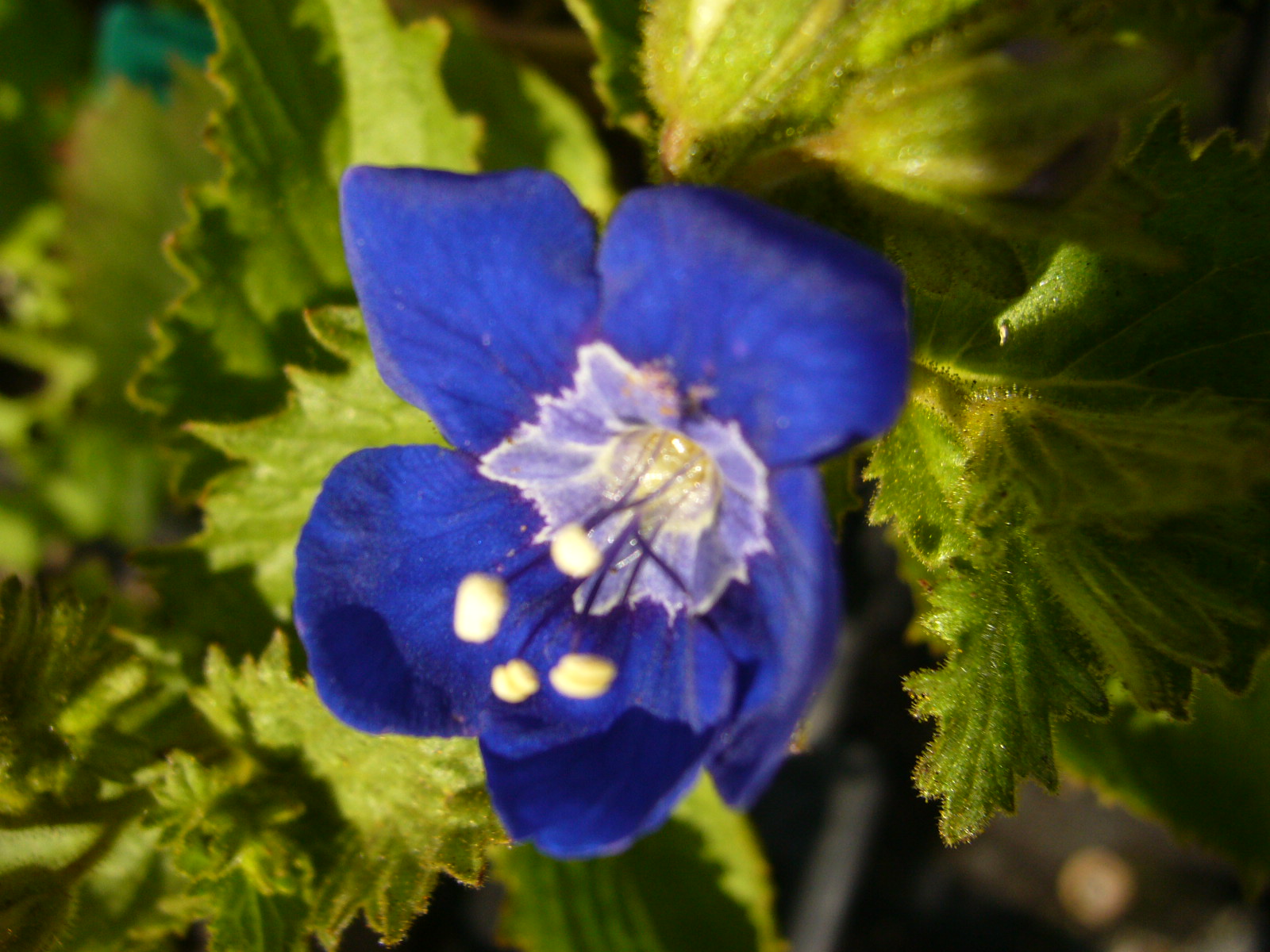
Sticky Phacelia (Phacelia viscida) at Annie's Annuals & Perennials.
I don't think I even need to mention what blue blooms do for a lot of people—myself included.
Rose Snapdragon, (Antirrhinum multiflorum) at Annie's Annuals & Perennials.
Some flowers you just want to touch and caress, and you wonder if you should purchase a whole new wardrobe based upon their merits—or at least a new pair of boots or some nail polish. (OK, maybe it's just me who thinks like this but I am becoming more and more convinced by messages I receive that a lot more oddballs are out there. Raise your hands! I know you're reading this right now.) 
Sticky Monkey-flower, (Mimulus aurantiacus) at UC Botanical Garden at Berkeley
But then there are the glowing blooms that brighten your way and shine a light down that plant path we must all wander down.
Mexican Prickly Poppy, (Argemone mexicana) at UC Botanical Garden at Berkeley.
I remember visiting the UC Botanical Garden at Berkeley for the first time and remembering how funny I used to think it was that my friend Sean Hogan worked as a curator there. As someone who'd studied art history, I'd never thought of curation taking place outside of an art museum or gallery. So I looked around and thought about how much visual literacy mattered in both of these arenas. 

I knew that I fit in when I thought about having compared hundreds of Christ images as an undergraduate and how that ability could easily overlap with a survey, say, of Agave—or any other group of plants. So similar to most, yet some of us just have a knack for discerning subtle differences—and these differences often matter a great deal and they tell us a lot. 

I'm not great at that game but I can spot and identify seed heads at great distances in their natural environment—sometimes while driving a car. It's a skill—a very strange one, but it's part of this whole process. 
Prickly Pear, or Opuntia bloom. 
I remember walking around, looking at the students and employees, and I thought about how sad I was that I'd been unable to complete the plant path long ago. I had to turn around defeated before I'd even really gone very far. 

My illness made physical activity and a lot of technical work too difficult. I had to slow down and at times I just didn't make much progress at all. My mind didn't work as well and I no longer had near perfect grades. It took years to discover I had swelling in my brain that was impeding me and inhibiting my growth as a person. I was trapped inside and I struggled for years to find the words to describe what I was experiencing. 

I turned to art to soothe and stimulate my mind. 

I moved indoors, inside of myself. Later I moved indoors because I had no choice. My immune reactions disallowed me from being outside. I had to look out the window and I started to play with seeds to keep the hope alive. 

Life circumstances prevented me from being able to return to any of these green dreams until these last few months. Now they surround me again and I am surround by green friends too who've made me feel so welcome despite my typically stylish and late arrival. Just when I wanted to give up hope after nearly 18 years things started to unravel in very mysterious ways. 

What matters is that I've arrived and I know why I'm here now and what I want to be doing. After a really long time, I feel like I've finally grown and that at long last I truly bloomed this summer. I've never felt like this before but I'm getting used to it. 
Elegant Clarkia, (Clarkia unguiculata). 
It's one foot in front of the other once again but this time I get to laugh and walk because I want to do so—not because I have to or need to do so. My load is so much lighter now—literally too. 

My mind is calm and silent now and I'm open to what's ahead of me. I have the mental space again and have found my old quiet personal nature waiting there for me. It was there all along waiting for me to be well enough to come by and pick it up and wear it again as my second skin. It's warmed me to the core to be myself again, and as time goes on, and I keep at this, I hope to better understand and explain my dormancy. 

Until that time, I will revel in the simplest of things, the blooms of summer and the magic they bring to gardeners and plant lovers around the world. I'm a believer and if you're here reading this, you probably are too. 

Monday, June 13, 2011

Mission San Francisco de Asís and Its Historic, Cinematic, and Photogenic Garden Cemetery


Located in The Mission neighborhood of San Francisco, this mission is also referred to as Mission Dolores. Its common name originates from a creek that once ran near the community named Arroyo de Nuestra Señora de los Dolores. Founded by Franciscans, it is named after my favorite Catholic hero: San Francesco d'Assisi. 

It is difficult for me to believe that I have been to the Bay Area almost twenty times in my life, and yet, this was my first visit to the city's oldest structure, a location made even more famous by its inclusion in one of my all-time favorite Alfred Hitchcock films, Vertigo.
I loved that the official plaque made it very clear that the original adobe walls and roof tiles were still intact.
The first Catholic Mass celebrated here took place under a shelter at this site just a few days before the
signing of the Declaration of Independence in 1776. These bricks had not yet all been formed and dried at the site. The building was completed in 1791.
Inside, the proof is made even more crystal clear. 
My namesake, St Ann(e), mother of Mary, is to the right of the crucified Christ and the Immaculate Conception Mary is to the left. Above St Ann(e) is St Clare, the founderess of the Poor Clares, or, the female Franciscans. Above Mary is her father San Joaquin. 
Without going into too much detail about the alter and its iconography, I can say that much is being said in this one that is rather atypical. Since I am such a plant and animal nut, it was really great to see such a formal alter for St Francis and all that he stood for in his work. 
Beside the mission church is the larger, more modern, Basilica. Seeing its main alter decked out with garlands of blooms and tons of flowers flooded me with memories. It also allowed me to show my husband where my penchant for springtime pagan-like bloom worship sprung from. 
Lastly, there is the famous cemetery. If you have not yet seen Vertigo, I promise to hide my shock. If you have, this is where Jimmy Stewart's character Scottie follows Madeline and he watches her as she sits and visits a gravesite.
This was the only Italian gravestone we found but there  were many in English and Spanish.  I was also really curious about many of the early Irish people who appeared to have been living here when it was still Mexico. That makes sense since it was Catholic. I'd like to learn more about these people now!
The gravestone from the film is no longer here, but there are plenty of real people to keep you more than entertained for an hour of so. Oh, and then there are the plants!
The plants are rambling all over the place.
If you go and you see something you like, there is a list of plants posted.
The architecture, the light, and the plants, made for an unimaginable visit that day.
Even though it was overcast, I could easily see why Hitchcock had picked the site. For many years the church actually left the gravestone of one Carlotta Valdes in the cemetery, but it became too much of a tourist site, and the stone was removed. I am not sure where it is now, but I am sure that it is out there somewhere.
In the film, this figure can be seen behind Scottie. It was once part of a grotto, and from online research, it appears to have been moved around a bit.
St Francis pacing in thoughtful prayer around the rose garden. He was a bit too large and lifelike for me.
I really liked this stone seat. Its permanence is unquestionable. 
A newer addition, this looks a lot like the spineless Prickly Pear developed by Luther Burbank. Against the white wall, it really stands out.
As always, the history of the site appears to overlap with that of my husband's ancestor who travelled on what was John C. Frémont's famous Third expedition. It is sad that Basil LaJeunesse became an historical footnote during that trip, but his death reverberated for many years in the lives of those closest to him. It is my belief, based on what I've been reading, that it was a loss both Kit Carson and Frémont were unsettled about since during the ensuing weeks they did things they later regretted.
I loved the casual feel here. The stepping stones, Sedum and hose make this feel so much like a garden.
One of the most controversial actions these men took involves this man.

This is the grave of the first mayor of San Francisco—though he was called an Alcalde and the city was then still Yerba Buena. Kit Carson shot and killed his twin sons and their distant cousin in 1846 near San Rafael when told to do so by John C. Frémont. This was just a few weeks after Basil's death, after they'd attacked and killed the wrong Native Americans to avenge the death in Oregon, and after they must have realized they'd been tracked by Modoc paid by the Mexican Government who'd been tracking them from their encampment near Monterey as they'd headed north of the border for safety.

So enough about all of that for now, you soon will be seeing more of Frémont as he has so many native plants that have his name attached to them. I just have to add this stuff because it is so much a part of why both my husband and I love where we live, between both the Pacific Northwest and California.
So the next time you find yourself in San Francisco, I invite you to sit and stay awhile. Meditate a bit and transport yourself back in time to a California before the Gold Rush, to a time when it was part of Mexico. 

Mission San Francisco de Asís or Mission Dolores
Related Posts Plugin for WordPress, Blogger...