Showing posts with label wildflowers. Show all posts

Monday, January 6, 2014

The Alaskan Honeymoon: Part Two (The Kenai Peninsula)

It's a shame it's taken so long to return to blogging about our honeymoon back in September 2013 but the installments seemed daunting. Alaska is a big place and is best experienced. I just didn't know what to say and I still cannot find the words. 

So, instead, I'm pressing forward. 

When I look at these images now I feel a lot and it's mostly silence, calm, and solitude. I'm not known to be silent, but I know what it is and what it means. In Alaska I felt it and I felt a deep calm I haven't felt in a long time. The solitude was much needed and I had a lot of time to reflect. It felt better than any spa treatment. 

There was space to breathe. 

Even though I'm now looking forward to traveling to Italy in a few months, there will always be room in my heart for Alaska. We will return. 

These posts find me pining away for it a bit too...
After hibernating for a day in Anchorage we drove south on Highway 1 to the Kenai Peninsula. I'd chosen it because of the Kenai River and because a garden client of mine is from Homer. I met her just after meeting my husband and when I told her we were discussing Alaska as a potential honeymoon destination she became very supportive of the idea.

(I'm so glad she did because she was a great help in our planning. I only wish we could have stayed in Homer longer but more on that next time...)
There were some goats up on the rocks somewhere not far from where we snapped this photo—wild mountain goats! 
This photo says a lot about the first day out on the road. The bride was still very tired and the groom was ready for an adventure.
Wild rose hips. 
Sadly, we rushed a bit on our way to the town of Soldotna. I regret not having stopped to take more photos but I was too tired and we both had no idea what the day would be like at all. The drive south was beautiful though and the landscape was unlike anything I'd seen before and as we drove we talked a lot about what it reminded us of so I'm left with a memory of that free-association game.

How do we become acquainted with new landscapes? We often familiarize ourselves to new environments by associating them with other places we've been to before and that's half the fun—at least for me. While John saw the Alps, I saw the Tetons.

After a week it became Alaska to us, but at first, we had to get settled.

(I suspect in the future we will be in Scandinavia talking about how it looks like Alaska to us, but I hope we'll see more of Alaska again before that trip takes place.)
Along the way we passed Kenai Lake and we were driving along the Kenai River off and on too. 

Considering I'd spent many years editing fishing books for my father's company, I expected to see something familiar. My eyes scanned the landscape and it looked like any other fishing hamlet. Later Dad told me on the phone about the trout fishing on the upper Kenai and I'm kind of fascinated by it now. I guess it's some world-class fishing I'd never heard about, but it's probably why it looked so familiar to me. There was a lot of fly fishing and it seemed a lot like home. 

My father's love of Alaska was a big reason for my having wanted to go there in the first place. Each year during my birthday in September he'd always be off fishing for salmon. He'd return with tons of fish, great stories, and usually a stuffed animal or piece of jewelry for me. I hated Alaska for many years. I was jealous of her. 

I'm the last of the Amato children to visit Alaska, but my purpose was as a naturalist more than anything else. It's what my father and I share. During the trip he called me more than he's ever called me in my entire life. Every other day he'd check in and he'd have me describe the weather conditions, the light, the surroundings, and I'd tell him about what we'd seen and done.  

In my usual way, our tour was unlike any of the trips my father had ever taken. He'd always been treated like a king. He'd been flown into fancy lodges. He'd land in Anchorage and then immediately fly out to a remote location on a float plane. We hit the ground, rented a car, and toured. It's the trip—I later found out—that my dad would love to take now that he's older and I hope he gets to do so. 

What interested him most was our access to good food, museums, and wildlife. He already knows about the fishing, but he hasn't seen the culture other than remote Native Alaskan villages. Traveling cheaply, eating well, and making the most of what we spent really sounded like a fun adventure to him.  
When we arrived at our hotel/motel in Soldotna, I had another moment of giggling. I loved this news advertisement. 

Alaskans have a sense of humor and we saw it all over the place. They are matter-of-fact too. (Just wait until the next post when I show you what makes news here.) Coming from Portland, this was such a relief. Nowadays Portland residents take everything far too seriously and they are so sensitive so it was fun just to live simply without any "major issues" being shoved in our faces. 

Not hearing about sustainability, livability, or seeing a hipster on a fixed gear bike for one whole week was another big part of the vacation for us. I don't think we heard the words "California" or "Bay Area" once. We didn't see women in yoga pants or a single Prius car. I'm not saying that it was Montana or Wyoming or even Idaho. It was just Alaska. 

Again, let me remind you of the silence we felt there. There was no hype. What you saw was what you got. We just were. The other people just went about their business. People were polite and friendly but there were no cultural agendas or lifestyles. I haven't felt that free in a very long time. 
Once at the hotel, John rested while I walked down to the river. It is a well-known fishing river and there was an elevated walkway with multiple fishing platforms for town residents and visitors. I've never seen a river so prepared and well-planned for salmon fishing. Since the season had ended, I had the walkway to myself. I walked along and watched spawned out fish corpses float by me.

The river was alive.
To my left was the riverbank. It was grassy and wild. There was also a small park with access leading down to the river. Looking up at the park bench it felt more like spring than late-summer.

As I walked along the river I could hear the ever-buzzing sound of small planes in the sky. It's another strange thing about certain areas in Alaska. You get used to the sound. So much so that when you return home you think that every car or truck you hear in the city is a little bush plane. You begin to miss the little tin mosquitos in the sky.

You also realize why it's the first thing you see hanging up high in the Anchorage airport—loud and proud. Those little planes are so important in this state.
The river was to my right. That day, it was a silent river that had overfilled its banks due to the heavy rainfall before our arrival. While I was there I was texting with a friend from high school who lives outside of Anchorage and she felt so badly that we'd arrived to Oregon-style weather. I told her we didn't mind, after all, it was our honeymoon. 
Holy Assumption of the Virgin Mary Church in Kenai. Founded in 1840. 
After we grabbed a quick bite we went for a drive to the town of Kenai to see this old historic site. The daylight hours were longer then and that day we experienced our first day of what I can only call prolonged nightfall. 

In the plane—as we'd flown north—I'd noticed how the light had changed. I hadn't really thought about prolonged daybreak and prolonged nightfall but they are wonderfully slow things that again need to be experienced to be understood. 

The world feels as if it's slowing down. In the morning, you don't feel like rushing. The one morning I watched the sunrise, it took what felt like hours to be fully light outside. It felt decadent. I felt powerless to the powers that be. I felt small in the grand scheme of the universe. That felt good and I was ok with it. 

Witnessing the light was something quite incredible. It was a light show. I've seen color bursts in the sky plenty of times here at home, but not light shows with colors fading in and out, blending with one another, shifting and then fading into another shade. This process simply goes on and on for several hours. Then when you think it's dark, it's not. There are still slivers of light in the sky. They fade out slowly like embers in a fire. Before you know it, you've lost track of them, and fallen asleep beside them. 

When you awake, the slivers of light are in the sky again. The embers brighten and heat up the sky, you feel warmth from the darkness, and then it is morning. This whole process takes a few more hours. It is happening all around you as you go about your travels. It becomes a big part of how you experience the place. 
On our way back we passed a nursery. Even though it was closed, I had to stop and look. By this point I was fascinated by the climate, the light, and I wanted to find a gardener and ask them all about it. I didn't get that opportunity, but I'd like to explore gardening in Alaska more in the future.
Their display garden was really pretty. I didn't poke around though because we had to get back. I was fading. The gardens I saw during our brief visit were utilitarian, but not Spartan. I only saw things from the car though, but again, it's something I'd like to read more about in the future. As always, I have a lot to learn. 
In the parking lot, we saw many more of the poppies that grow so well in Alaska. Papaver nudicaule is meant for this place as are many other poppies.
After another long day of adventure, it was becoming clearer to us that Alaska is a really big state. As we drove and talked about this, we realized just how much we wanted to see more of its beauty in the future. One long week in Alaska is nothing. We estimate that it will take at least 5 more trips to see every climate Alaska has to offer. Sure, this is true of virtually anywhere, but most places aren't surrounded by that much wilderness, with such extreme climates.

To be continued...
(Next stop, Homer, AK.)


Friday, August 31, 2012

A Few Blooms of Summer and the Plant Path Ahead

As summer begins to wind down here in the Pacific Northwest (and we enter into my favorite time of year), I thought it might be a nice time to review a few beautiful blooms of summer.

Many of these images are older ones—so forgive me if you've seen them before somewhere on here.
Love-in-a-mist after it's finished blooming (Nigella damascena).
The traditional school year begins soon. Maybe you've noticed all of the back-to-school fanfare and hoopla whenever you go shopping? I know I walk into stores wondering what back-to-school plants look like but I'm still not sure.

(Let me know if you have a clue. Somebody must have marketed something for just this occasion. I just know it.)
California Poppy, (Eschscholzia californica).
So, maybe this might be a good time to mention that I've finally taken into consideration how many folks I've been chatting with recently who've mentioned that I should stop acting like such an amateur and admit to the fact that maybe I could grow beyond where I've been making circles in the dirt with my fingers. (This is how I perceive their thoughts on the subject. I may have filtered their comments through some rather large tumblers of gin and tonic this past weekend so I'm a bit fuzzy on exactly what they said, but I got the gist of it.)
Large-leaved Lupine, (Lupinus polyphyllus). 
Ok, darling friends of mine, you win (and I know at least one of you regularly reads my posts so thank you C).
Western Columbine, (Aquilegia formosa) along the Smith River in CA.
I'm going to admit to having an aptitude for the sport, but with some reservations. As I write this, straddling my words loosely between images of an Aquilegia and Mimulus I shot while visiting the Smith River in Northern California last year, I should mention that right after I took these pictures I fell and gave myself severe whiplash.

Just sayin'.
Common Monkey-flower, (Mimulus guttatus) along the Smith River in CA. 
But let's get back to some of those summer blooms [insert awkward transition here].

There are so many amazing little plants and blooms for our sentimental green souls to treasure and like so many others, I have that insanely nerdy desire to know how, where, and why they grow. That's why many of the plants you see here I've grown from seed at some point, or else I had plans to play with that process this past year, but it had to be postponed until now. 

Yes, I can "announce" too that I will be back to my old routine soon and the basement will be filled with light and life this winter and I will stratify outside and I will be so happy about it. 

Yes, it's these subtle little touches in the natural world which matter and are important. It's these blooms that often have idiots like me coming back over and over. 
Calico Monkey-flower, (Mimulus pictus) at Annie's Annuals & Perennials.
Some of them are just amazing and you know of few other sights quite like them.
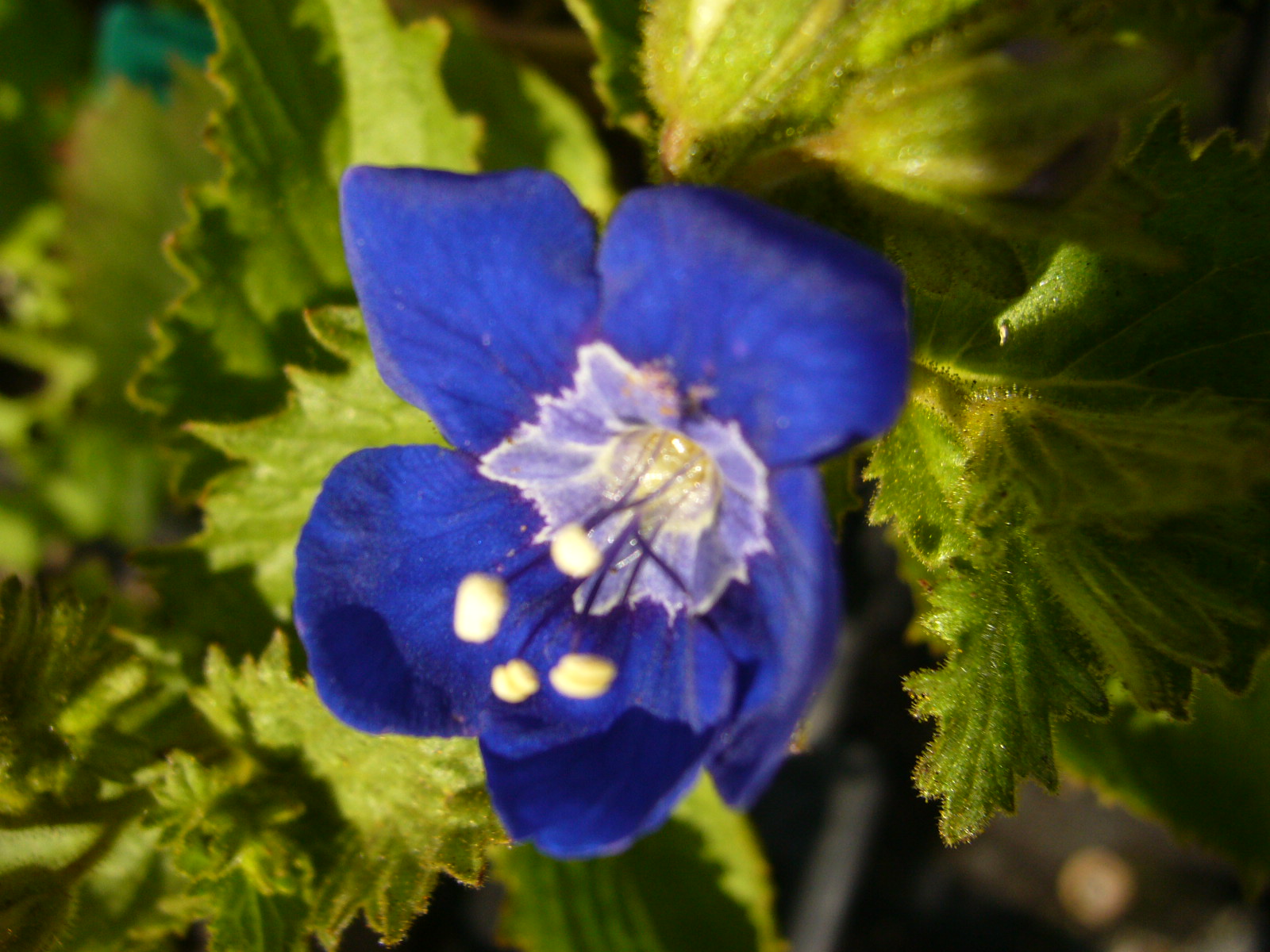
Sticky Phacelia (Phacelia viscida) at Annie's Annuals & Perennials.
I don't think I even need to mention what blue blooms do for a lot of people—myself included.
Rose Snapdragon, (Antirrhinum multiflorum) at Annie's Annuals & Perennials.
Some flowers you just want to touch and caress, and you wonder if you should purchase a whole new wardrobe based upon their merits—or at least a new pair of boots or some nail polish. (OK, maybe it's just me who thinks like this but I am becoming more and more convinced by messages I receive that a lot more oddballs are out there. Raise your hands! I know you're reading this right now.) 
Sticky Monkey-flower, (Mimulus aurantiacus) at UC Botanical Garden at Berkeley. 
But then there are the glowing blooms that brighten your way and shine a light down that plant path we must all wander down.
Mexican Prickly Poppy, (Argemone mexicana) at UC Botanical Garden at Berkeley.
I remember visiting the UC Botanical Garden at Berkeley for the first time and remembering how funny I used to think it was that my friend Sean Hogan worked as a curator there. As someone who'd studied art history, I'd never thought of curation taking place outside of an art museum or gallery. So I looked around and thought about how much visual literacy mattered in both of these arenas. 

I knew that I fit in when I thought about having compared hundreds of Christ images as an undergraduate and how that ability could easily overlap with a survey, say, of Agave—or any other group of plants. So similar to most, yet some of us just have a knack for discerning subtle differences—and these differences often matter a great deal and they tell us a lot. 

I'm not great at that game but I can spot and identify seed heads at great distances in their natural environment—sometimes while driving a car. It's a skill—a very strange one, but it's part of this whole process. 
Prickly Pear, or Opuntia bloom. 
I remember walking around, looking at the students and employees, and I thought about how sad I was that I'd been unable to complete the plant path long ago. I had to turn around defeated before I'd even really gone very far. 

My illness made physical activity and a lot of technical work too difficult. I had to slow down and at times I just didn't make much progress at all. My mind didn't work as well and I no longer had near perfect grades. It took years to discover I had swelling in my brain that was impeding me and inhibiting my growth as a person. I was trapped inside and I struggled for years to find the words to describe what I was experiencing. 

I turned to art to soothe and stimulate my mind. 

I moved indoors, inside of myself. Later I moved indoors because I had no choice. My immune reactions disallowed me from being outside. I had to look out the window and I started to play with seeds to keep the hope alive. 

Life circumstances prevented me from being able to return to any of these green dreams until these last few months. Now they surround me again and I am surround by green friends too who've made me feel so welcome despite my typically stylish and late arrival. Just when I wanted to give up hope after nearly 18 years things started to unravel in very mysterious ways. 

What matters is that I've arrived and I know why I'm here now and what I want to be doing. After a really long time, I feel like I've finally grown and that at long last I truly bloomed this summer. I've never felt like this before but I'm getting used to it. 
Elegant Clarkia, (Clarkia unguiculata). 
It's one foot in front of the other once again but this time I get to laugh and walk because I want to do so—not because I have to or need to do so. My load is so much lighter now—literally too. 

My mind is calm and silent now and I'm open to what's ahead of me. I have the mental space again and have found my old quiet personal nature waiting there for me. It was there all along waiting for me to be well enough to come by and pick it up and wear it again as my second skin. It's warmed me to the core to be myself again, and as time goes on, and I keep at this, I hope to better understand and explain my dormancy. 

Until that time, I will revel in the simplest of things, the blooms of summer and the magic they bring to gardeners and plant lovers around the world. I'm a believer and if you're here reading this, you probably are too. 

Tuesday, August 28, 2012

Sexy Wild Wildflower Moments (The Touch-Me-Not)

Common Jewelweed a kind of Touch-Me-Not, (Impatiens capensis). 
This is a post about something that's a common experience, and it's probably happened to you too.

Gardeners and plant people see the world differently, but we're human after all, and many of us can also be sentimental in how we see the world around us. Sometimes this can help us when we're not feeling so comfortable. It's through these stories we often find our own release and can be set free again.  

Here's my story. 

Anthropomorphizing isn't just for poets, or maybe it is...

Sometimes we just see wildflowers, but at other times, we grab them and want to hold onto them and own them. So often they are ephemeral and delicate and once picked they droop and fade quickly. They're not often as sturdy as other plants. And yet, that's what makes them so special to us. 

Our human desire to capture that brief momentary beauty can be a rush that evokes in us a kind of lust for something we can never truly possess. 

And wildflowers are necessary to us because they are not the shrubs or trees in our lives. They are something far more special and their beauty touches us much differently. 
If I were a wildflower, I'd be a Touch-Me-Not. In my moment I don't just droop over and let my seeds trickle out, or worse yet, blow away in the wind. This is not the showiest of seed heads, but it's energetic and active.

I am a seed collector and I've grabbed many wildflower seed heads—but only after their blooms had faded and the plants were near gone.

This summer I reached out and grabbed a wildflower and it faded quickly and when I went back to look inside for seeds, there were none.

Someone had been there long ago to drain the plant of its seeds. So now I'm walking away empty handed—but with the memory of the momentary pleasure of the bloom.

Wednesday, June 13, 2012

Wordless Wednesday: Walking to the End of Spring

Possibly Lonicera periclymenum. 
Sambucus nigra 'Black Beauty'. 
Phacelia tanacetifolia.  
Most obnoxious Roses ever! (I kind of like them.)
Lychnis coronaria with Eschscholzia californica. 
Lychnis haageana 'Molten Fire'.
Pericallis. 
Fragaria vesca. 
Rosa 'Jeannie La Joie'. 

Saturday, April 9, 2011

Plant Hunting Along the Beaches of the Southern Oregon Coast


Lovely rustic yurt courtesy of the Oregon Parks and Recreation Department, Harris Beach State Park, near Brookings, Oregon. (These begin at $39 per night.)
Waking up in my yurt to the sound of the rain tap tap tapping was not an ideal way to spend my spring break, but I am an Oregonian so I was more than prepared to deal with it. With my old sleeping bag from back when I used to backpack up mountainsides, and a Pendleton blanket with a big salmon on it that my dad had given me, I had slept very well the night before and I was ready to head out for an expedition of my own. My plan was to drive at whatever pace I felt like to my next destination, and to have fun and to relax while doing so. I had no idea which native plants I would see because I'd promised myself not to plan this all out in advance. I was just going to look at whatever I could find and make note of it. I also took along not only my handy digital camera, but a Holga and a funky Japanese camera too. With some special film inside, those other cameras should turn out some great images, but of course, I have to wait for those to be developed. I can wait.
Our large trees can become very dangerous during the winter months especially when the waves are unpredictable.
The last time I drove through Brookings it was Thanksgiving 2009 and my husband and I were driving to Gold Beach for the night. As we flew into town I saw a sign for an Azalea Park and that was news to me! I thought I knew about all of the plant parks so I vowed to return. Over a year later, there I was last week, after having visited the harbor for some coffee for the road.
The ancient native azaleas in this thirty-three acre park have been here since Lewis and Clark visited—what was to later become the state of Oregon—back during the winter of 1805-1806. (Sure the Lewis and Clark Expedition was nowhere near these shrubs, but that's a long time for a shrub to live so it should be noted I guess.)

No one really noticed or cared much for this stand of plants until 1937 when inspired folks cleared the old pastures, removing the overgrown vines, and later petitioned to have the native shrubs designated as a State Park. From 1939-1993 their wish was granted, but then in 1993, ownership and maintenance of the park reverted to the City of Brookings. Since then, it has been revitalized, with many new additions, and it is currently looking absolutely wonderful.


The group of volunteers that has stepped in to care for the park has done so because there are five varieties of endangered native Azaleas here. They knew what a treasure this is, and thanks to them, we still have these plants to enjoy.

I was only a bit sad that the plants are not labeled at all, but it may be done in an effort to keep people like me from snipping at them. I am unable to find information about the actual plants online, and I would love to know more about all of them, and genetically what makes them special, but as for as I can tell, the only native azalea is the Western Azalea (Rhododendron occidentale) so these must all be different natural varieties of the same plant. Curiouser and curiouser... Yes, now I see it all clearly. The link really helped.

The next stop was the Pistol River and its wayside. I had to stop there because it had been the name of my yurt the night before. Not only did I have the whole vista to myself that morning but, lucky me, I found some random plants sitting here and there not far from the car. I also found a bit of history.

When I read this Oregon History sign I thought again of genealogical history but this time it was my husband's and not mine. At the time this skirmish occurred, during March of 1856, my husband's French Canadian ancestors had already been busy in the West for quite some time and had already made history themselves. Ten years beforehand, a relative of my husband's was also attacked and killed in Southern Oregon, but it was while he was camped on Klamath Lake in the interior with an expedition party. One month later that same group was back in California taking part in the Bear Flag Revolt in a very strange moment in the history of California.

Basil LaJeunesse was killed while the group slept beside the lake one night. It was an Indian attack and he received a hatchet to the head on May 9th, of 1846. Asleep beside him was his dear friend and expedition companion, Kit Carson. Yes, it was that Kit Carson.

Working with John Frémont, the American military officer and explorer, they'd both been hired to travel to California along with a group of fifty-three other men by the President of the US. It was officially an exploration party, but in reality, they were being hired to spy on the Mexican government in California. The Mexican officials figured it out and they were asked to leave. That's how they ended up just over the border in Oregon Territory. That night Frémont had forgotten to post a guard because he was waiting to receive word from the President as to how to proceed with California since at that time, they'd expected a fight with Mexico. The fight never occurred.

Back home in Wyoming, Basil's older brother married a Shoshone woman from Southern Oregon and he opened up a trading post named in his brother's memory. Fort Seminoe (after his brother's Catholic baptismal name) operated from 1852-1855. The Oregon Trail went right past their front door as did the Mormon and California Trails. (Four of my great-great-great grandparents walked right past Charles and his wife on their way from Kentucky to Oregon and if they'd only known someday I would marry one of their descendants I cannot imagine what they would have thought.) Eventually, as tensions with the Natives Americans grew, Charles was forced to hand the fort to the Sioux in 1855 and during the same Indian War era, he left to work as a tracker, and was killed somewhere on the Yellowstone River. His body was never found but each year tourists and fly fishermen flock there like geese. It is still hard for me to blend these two different histories of a place together since they honestly slammed together rather quickly during the last few generations but I am working on it. The fact that my father has made a life for himself as a well-known fly fisherman has only served to convolute this whole funny reality even more.

I own a copy of the journal Frémont wrote during that fateful expedition and it has great plant descriptions throughout. It is kind of a nice read to be honest, but it is still shocking to have learned all of this about my husband's past and to tie him to historic characters mentioned in books is still strange.

Due to adoption, none of this information was known until recently. All I can say is that it is hard to change how you see your place in the world when you are in your 30s. One day you know your story, then the next, well, you're simply forced into becoming a different person. Going through this experience with him has been fascinating but it is slow going.

I return to plants again, and though the tangent may seem a bit off, I hope you enjoyed it. More bits and pieces will appear from time to time. 
Coastal Strawberry (Fragaria chiloensis).
I don't know what this is either but it was hanging in up high above the ocean so I figured I should include it too.
This must be some kind of Manzanita. 
I have no idea what this is, but I am sure that one of my friends will let me know. 
I'm not sure how long it was before I stopped again, but I did not too far down the road. The ocean was amazing that day and I was beginning to get more and more excited about all of the plantlife I was finding all over the place. In so many ways, I was really happy that day. After a long winter, and a lot of medical issues, that day was just the right thing. 
I have no idea what this was, or if it was even native, but it was there.


This is some kind of Lupine with a grass.
Sea Pink (Armeria maritima).

Just off the highway and all to myself.


When I landed in Gold Beach, I pulled over to take these pictures for those of you who have not yet seen what we have here in Oregon for our tsunami public education signage. I like the signs a lot and am happy that public safety efforts have started in our state, but we are far from ready. When the earthquake hit Japan just a few weeks ago many of us already understood that meant to take cover and to use caution but we were certainly not ready for anything.

Luckily we were not wiped out, but we will eventually begin finding the debris from Japan on our coastline. It is expected to arrive in 3 years but it may only take 1 year.

I am fairly confident that the mess will arrive here just as the many fishing floats have for years and years. Beachcombers have always cherished the blown glass objets d'art but something really different is heading our way now.
Just down the road at the beach I discovered this nice little piece of ingenuity. When I was a girl, I used to make shelters like this with my friends and their families. At camp, we also learned how to make ones with tree boughs for a roof. Transported to any garden setting, this would be really wonderful, especially in a stumpery.

A wind shelter, Gold Beach, Oregon.
This is why I was really there though. Like many others, I drive to this part of our coast for the rocks—the beautiful rocks that I handpick for my garden.
Agate hunting, Gold Beach, Oregon.
After loading up the reuseable grocery bags I jumped back into the car and headed north. Again, I randomly selected several waysides and parks and was delighted by all of the additional plants I was able to spot that day.
Oregon Myrtle or California Bay (Umbellularia californica).
I am not completely sure of the mix here, but there are at least three native plants I can spot I just cannot recall all of their names right now.
Ok. It was a grave wayside. Again, the Native Americans are blamed as having massacred but I have such a hard time with that since we were taking all of their land and resources away from them. Still a very touchy subject for many Americans and when you see things like this you really have to stop and wonder. I am sorry they lost their lives, but I am glad that this park was set aside for us to sit and think about this dark part of our history.  
Not sure of ID, but it is really pretty.
Yellow Prairie Violet (Viola praemorsa).
Rattlesnake Plantain or Rattlesnake Orchid (Goodyera oblongifolia).
Red Flowering Currant (Ribes sanguineum).
Stuff that looks like Kraft Macaroni and Cheese but it is actually something slimy growing on the tree.
Skunk Cabbage (Lysichiton americanus).
Sweet Coltsfoot (Petasites frigidus). 

Non-native Teasel (Dipsacus fullonum).
Unknown Oxalis.


Rock collecting opportunities.
This is the only native Sedum spathulifolium 'Cape Blanco' that I ran across and it was on a suicide mission in the sand so I liberated it to higher ground. This is a really slow-growing sedum at my house for some reason but I have no idea how one kind can grow so quickly and another slowly. 
Unknown coastal pine.
Evergreen Huckleberry. I HIGHLY recommend these bushes for their berries.  (Vaccinium ovatum).
Not sure if this is Usnea lichen but it looks like it. This is not moss. If we have 20 words for rain in the NW, we have at least 200 names for different kinds of creepy things that grow on trees. 
It's another Oregon Myrtle though I prefer Headache Tree because it is so strongly scented. (Umbellularia californica).
Salal (Gaultheria shallon).
Red Flowering Currant (Ribes sanguineum).
Ocean of non-native Gorse (Ulex europaeus).
Stand of native Pacific Coast Iris on a hill facing the Pacific Ocean (Iris douglasiana).
Not sure exactly exactly what this is. 
Cannot remember the name but this one is familiar.
Female Coast Silk Tassel shrub (Garrya elliptica). The male catkins are much showier and longer and often show up in photos. I tried to find some, but all that was available were the female catkins which were still clinging to ripe seeds from last year. Impressive and fruitful.  
I have no idea what this fern-like thing was that I found growing in a flooded meadow. Any hints botanical buddies??


Bearberry of Twinberry Honeysuckle (Lonicera involucrata var. ledebourii). These are pretty plentiful all along the way but nevertheless I kept finding myself wanting to take picture after picture of their little blooms.
Some of the last flower pictures I snapped were of these two lovelies. I am pretty sure the are Clarkia, but I really cannot figure out which one they are. Maybe someone just tossed seeds out the window to see if they would grow down at the coast in a pretty harsh environment where a river meets the ocean. They looked native to me though.

As I rolled into Coos Bay I was greeted by the sight below. Part of me could not help but think of the movie The Goonies and my thoughts went up Highway 101 to Astoria. What a great day I had and right now I really wish I was back on the road.


Related Posts Plugin for WordPress, Blogger...