Showing posts with label Japanese gardens. Show all posts

Friday, August 17, 2012

O-Bon, the Spirit Festival at the Portland Japanese Garden

One of the key reasons I annually renew my membership to the Portland Japanese Garden is so that I can attend this members only event each August. During this time of year in Japan, for 3 days each summer, there is a spirit festival which is considered a homecoming of sorts to welcome back the spirits of ancestors into your home and life. Ever since my first visit to this festival, back when I was still a teenager, the Rev. Kodachi has led the Buddhist ceremony. I am honored to know both he and his wife. (I used to work with Mr. Kodachi during the summer for a week-long Japanese exchange program he created and Mrs. Kodachi just so happens to be my ikebana sensei.)
Before the ceremony, guests gather for Bon Odori. Of the 3 dances performed last night, this is the one I'm most familiar with since I learned it years ago. It is the dance of the Tankō Bushi or "coal mining song."
Guests enter the garden after the performance, and as the Rev. Kodachi chants, we are handed candles that are later lit and are floated on the pond en masse. 
Guests continue on and gather on the Moon Bridge. They can be seen to the left. 
Sadly my Grandmother Virginia's name was not read, but when my candle was sent out, I thought a lot about her. 

To my great surprise, for the first time, I heard much more weeping around me from the other guests and it made me smile.
I looked up at the night sky through the pine needles above and I thought about how she and I used to cry together so often. This would make us turn to laughing eventually and giggling about being such sensitive women. Grandma called us crybabies and she used to apologize that I'd inherited her traits but I'd comfort her by telling her that my sensitivity made me strong by making me vulnerable and honest. 

We both knew we had the horrible fate of being born with the hearts and souls of poetesses. Those around us did not understand this, and in my case, they still don't, but it's ok. Grandma feared others really knowing her, and knowing this weakness she had, but I am so proud she gave it to me too and I thanked her last night since it's what has made my life so unique and special. She gave me my heart and soul. This is a beautiful thing to give a woman and I am grateful above all else to her. 
The alter. 
After the event was over, I spent additional time speaking with the Rev. Kodachi, Mrs. Kodachi, and their son—whom I haven't seen in years. I met two of their granddaughters and I was filled with that happiness I so often have when I see small little women. We spoke of my divorce, my health, my plans for the future, and then I promised to return to ikebana classes next month.

I have my spirit back now and I very much look forward to moving on in my floral arranging studies. Ikebana is my art form and poetry and I really hope to keep doing it for many years to come.
The lights collecting, reflecting in the water, the koi sleep beneath. 


Sunday, October 23, 2011

Ikebana International Chrysanthemum Exhibition: celebrating Kiku Matsuri

Yesterday I attend Ikebana International Portland Chapter 47's annual Chrysanthemum Exhibition at the Portland Japanese Garden. As expected, it was amazing, and I truly enjoyed viewing all of the different arrangements. 

Following are a few of my favorites from the show. (My Sensai's is the last arrangement in the Sogetsu School section at the end of the post.) 


Saga Goryu School
by David Komeiji
by Mieko Heriford
by Wako Henjyoji
by Luci Bachelor


Ohara School 
by Selina Lechner
by Betty Robinson
by Ruby Warren


Ryusei-Ha School
by Reiko Grenade 
by Kathleen Birchfield
by Judy Harpel

Ikenobo School 
by Dr James Skog
by Elly Heitmeyer
by Jack Smeckar


 Sogetsu School
by Diantha Knott
 by Keiko Kodachi


Thursday, July 21, 2011

Garden Blogs Flinging Themselves upon Seattle! (Pre-Fling Prep Course: Kubota Garden)

Grrrrrrr. I'm an anatomically incorrect stuffed eel toy and I'm about to take Seattle! I'm a lean, mean, green, garden stalking machine. 
The Amateur Bot-ann-ist has never been a flinger, but I'm flinging this year to give it a shot. I'm almost always open to new garden viewing opportunities, especially when my cohorts are not kids groaning in the backseat. Garden Bloggers Fling 2011 (Seattle). 
My husband needed a break from California so he came with me. After our arrival, I tagged along while he accomplished some work. There is a tasting planned for this Saturday so first we dropped off several cases of wine at the Fremont Wine Warehouse. Then we jumped back on the freeway and headed back to another shop. I marveled at the greenery both times we passed through downtown. Due to our wet and mild summer it is looking even better than usual.
While he was pouring samples at another shop in West Seattle I sat in the car and played with my new camera. It's a Canon PowerShot SX30 IS and I think I'm in love. Seriously.
While I was in the car I realized that on our way back into the city we could revisit a garden that I'd only seen once during a winter trip to the Northwest Flower and Garden Show: Kubota Garden.
We bloggers will be visiting the Bloedel Reserve on Monday so the least I could do was revisit the garden left behind by Fujitaro Kubota. He was a Japanese immigrant from the island Shikoku, a self-taught gardener, and a man who became a keystone to what is called the Northwest Garden Style. He also designed the Japanese garden at the Bloedel Reserve. 
An island of Bergenia cordifolia. 
After having seen the Kubota Garden during the winter, I have to admit that today it felt like an entirely different place.
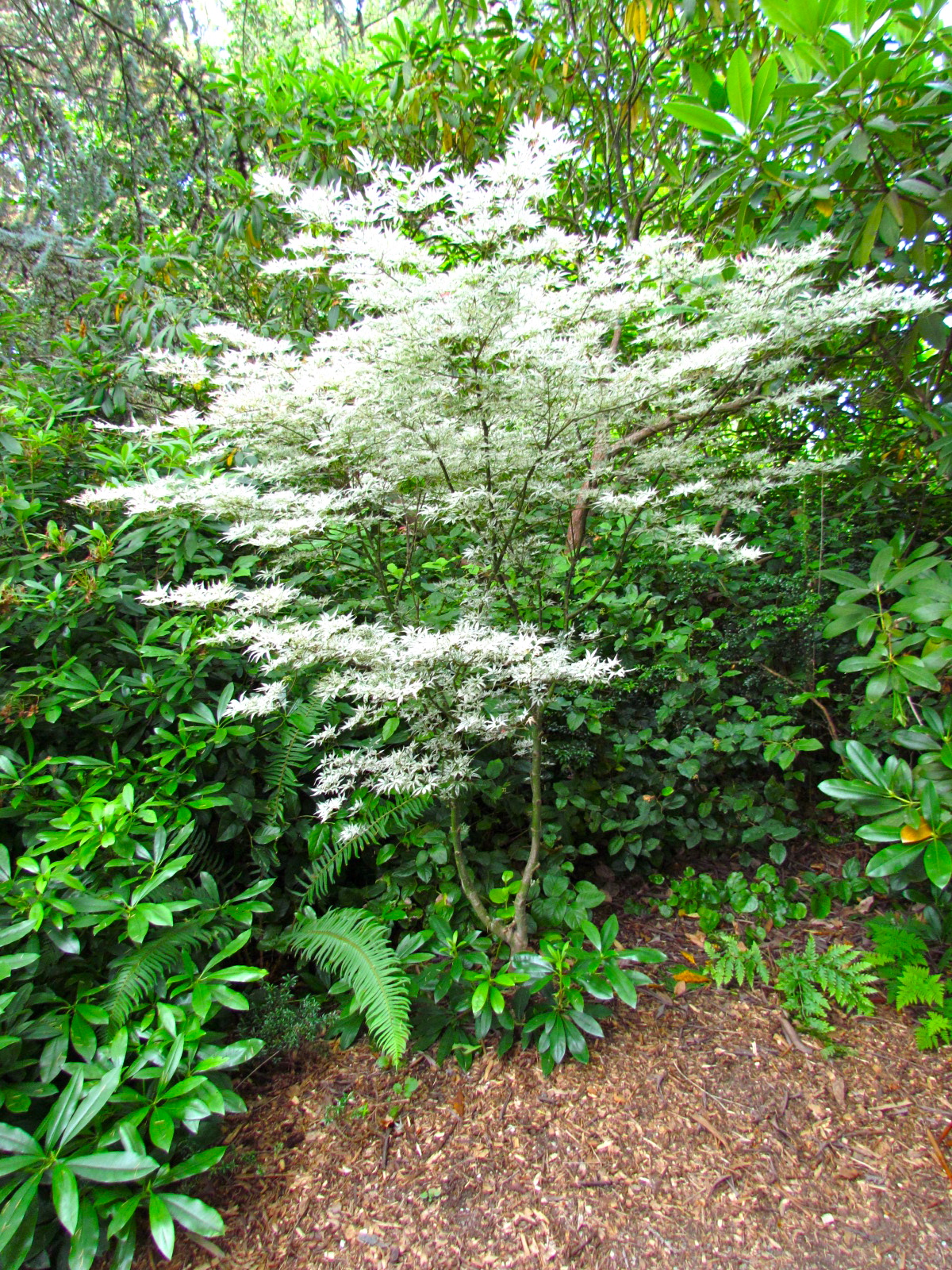
Acer palmatum 'Ukigumo.'
This Japanese maple, known in Japanese as the "Floating Cloud Tree" took my breath away.
The green canvases he painted with a textural brush are so calming and peaceful.
As you walk through the scenes, experiencing the layers, it feels cleansing and refreshing.
 There are nooks and paths that lead to views.
You may even find a place to rest in the small forest. It was planned and planted in such a way as to make the space seem larger and longer. This is very pleasing to the eye.
There are two red bridges. One bridge is lower and wider.
Red berried of a Vaccinium parvifolium.
There were native red huckleberries.
The other bridge is higher and is more of a Moon bridge.
As we left the garden we both noticed the construction that we'd seen several years ago was now complete and that they'd added a new wall and passageway into the garden. The contemporary construction includes "tiles" made of rusted metal rectangles which truly enhance the garden with their weathering. Additionally, the concrete blocks reminded me a great deal of the Gordon House, designed by Frank Lloyd Wright, where I used to work. Do you like the wall finished or unfinished? I love either, but I think that the raw and unfinished wall could look a lot worse. It truly is kind of interesting.
I've not yet met any of the other garden bloggers, but I certainly feel as though I've arrived. I look forward also to deeper contemplation of the Northwest Garden Style that means so much to me. Cheers to you Seattle!

Wednesday, April 27, 2011

Garden Flaws: How to Improve Aluminum Windows Blocking Your Complete Garden Vision

Our home was built in 1911, and during the last 100 years, some things have been changed. Sometimes these changes don't sit well with the real integrity of the house, and for me, one of these many beefs I have is with the aluminum windows on the back of the house. They just don't fit in with the rest.

Originally, the back of the house had a large sun porch and a butler's pantry. Much later, the wall between these rooms was removed, the door to the kitchen was covered up, and the large windows were replaced with these cheap aluminum ones. I love the extra back room, and the lack of kitchen storage space is something we deal well with, but the windows drive me nuts.

In a perfect world, I'd replace them and put back the appropriate windows, but this is not that world. Usually, each summer I hide the windows with plants from the outside, and this year is no exception. I intend to grow all of my Christmas cacti in these old hoops soon. The sight of the plants is almost always distracting when you have them all hanging in a row, but what about a solution? I need a solution I can afford!
Then I noticed this amazing window treatment at the Portland Japanese Garden last weekend at their annual plant sale while I was standing in line. It's brilliant and I think it would look great! Our garden is a mess right now, and it is hard to see all of this clearly through the debris, but I think this is the new plan. 
Don't you agree? (I should add that we have plenty of other Japanese elements in the garden and this might actually begin to tie them all together. So often the details are so easily overlooked.) 

Monday, March 28, 2011

Hakone Gardens (Saratoga, CA)

Located in Saratoga, California Hakone Gardens may very well be the oldest residential Japanese garden in the entire Western Hemisphere. Created by two patrons of the arts from San Francisco the garden was designed and the buildings were built by local Californian Japanese-American landscape architects and architects in 1915. The first building built was the Moon Viewing House that is seen in the photos below but additional buildings were added later by Isabel Stine and later owners. 

The Moon Viewing House was built using a style of architecture preferred by samurai and in my opinion the garden is also designed with a kind of energy that is incredibly active making the garden feel lyrical. Compared to meditation gardens, and other kinds of serene Japanese gardens, which are also included, it really made the whole setting symphonic and we lingered there for a lot longer than we'd planned. 

The garden was purchased by the city of Saratoga in 1966 because Hakone had fallen into such disrepair. Since that time, luckily, it has been restored. 

Now for the best part, if you have seen the movie, Memoirs of a Geisha (2005), you have already seen the garden a little bit since it was used as a filming location. I unfortunately do not remember the movie well enough to tell you any more than that though.

It is a beautiful garden, and unlike other gardens I have visited. The fact that if overlooks Silicone Valley is rather charming too. 

(PS: Hakone Gardens is also possibly connected to the famous fortune cookie debate. If you were unaware that they were originally made by Japanese Americans, you should read more about it. It is a pretty funny food history and I love tales that get people so wound up.)
The common houseplant Variegated Spider Plant (Chlorophytum comosum Variegatum).
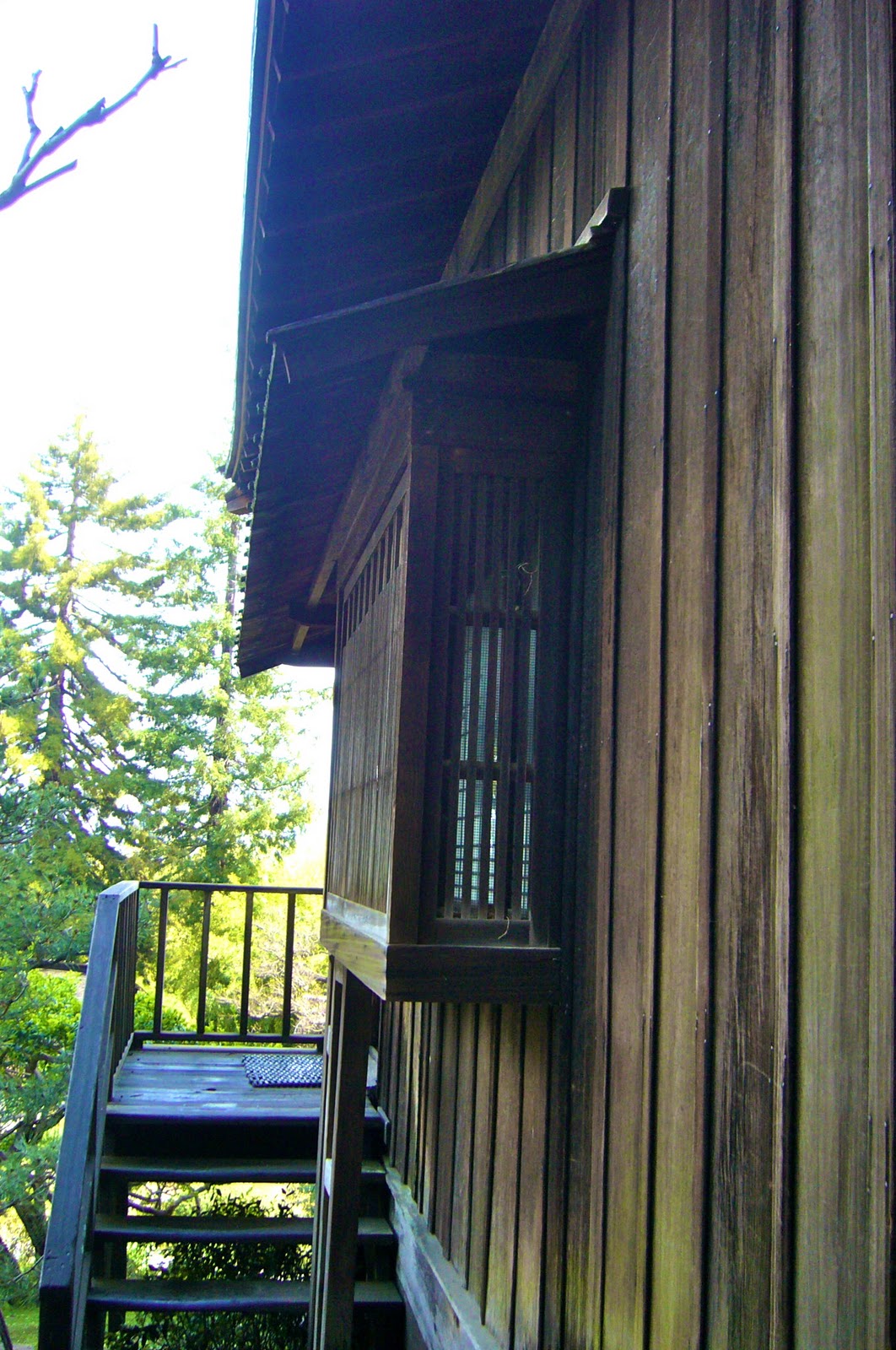
Moon Viewing House.
Amazing Weeping Japanese Maple. 
Native Californian Arctostaphylos. The red back and the yellow green of the bamboo contrast nicely. 
Tea House.
Moon Viewing House.
Master Stone.
Garden protector.
This is great joinery.
Entrance to Moon Viewing House.
I cannot recall right now what this was officially called, but it was the most amazing part of our visit.
From inside, each of the opening worked perfectly to frame the garden as if you were looking at art on the wall.
This design technique is something we in the West have tried to master too but the Japanese garden is not complete until you have completed this effect.
The light was bright, but everything lined up perfectly to please the eye. 
Tomorrow I will post scenes from Flora Grubb Gardens in San Francisco. As for today, I'm off to see my old friend the Pacific Ocean. I plan to send my happy thoughts to Japan while I collect agate stones along the beach for our garden. It will be a nice way to spend the last two days of my vacation before returning home. 
Related Posts Plugin for WordPress, Blogger...